


Panchamahabhuta: The Five Elements in Ayurvedic Philosophy

Dr Leshma Vijay

Consultant Physician
The Nattika Beach Resort
Panchamahabhuta in Ayurveda describes how all life is shaped by five subtle building blocks, and how those same elements shapes our life, body and mind. Rather than a Ayurvedic philosophy, it is a way to observe qualities in nature and within ourselves, so daily choices can be more harmonious. This practical lens encourages awareness, steadiness, and a gentler pace of living.
Understanding the five elements in Ayurveda
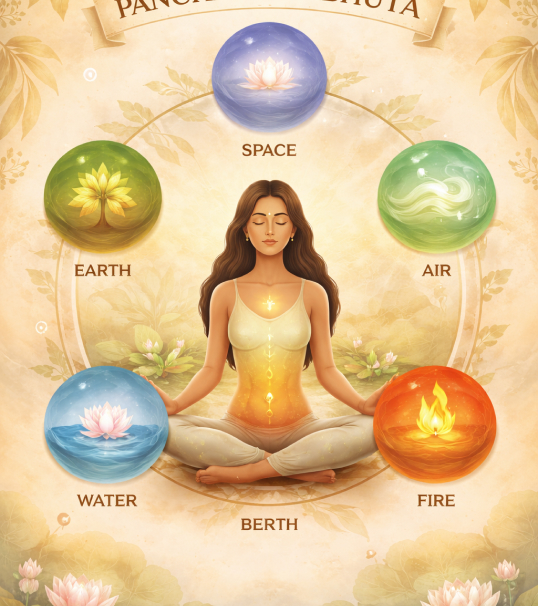
The five elements are often described as qualities that can be sensed and felt. This framework is sometimes called the panchamahabhuta theory. Each element is present everywhere, yet one or two may be more prominent in a person, a season, or a food.
- Earth which is responsible for the stability, structure, and form
- Water helps in cohesion, fluidity, and nourishment
- Fire the transformation, warmth, and clarity
- Air is the reason for movement, lightness, and mobility
- Space gives the openness, subtlety, and connection
These are not rigid categories. They help us notice how texture, temperature, taste, sound, and rhythm shape experience. In this way, the elements reveal a natural continuity between ayurveda and nature.
Panchamahabhuta and the human body
The body reflects elemental qualities everywhere. Bones and muscles express earth. Blood and lymph express water. Digestive warmth reflects fire. Breath and circulation express air. The spaces in joints, the hollow organs, and the quiet within the mind reflect space.
Senses also relate to the elements. Smell aligns with earth, taste with water, sight with fire, touch with air, and sound with space. When these channels are clear, perception feels sharper and more at ease. When they are burdened, the same senses can feel dull or overstimulated. Using the elements as a guide, small choices in routine, rest, and food can help restore steadiness.
Relationship between Panchamahabhuta and doshas
The doshas are patterns of elemental qualities in the body. Vata arises mainly from air and space. Pitta arises from fire with a touch of water. Kapha arises from water and earth. Each person has all three in a unique ratio.
- When Vata predominates, lightness, dryness, and movement are more noticeable.
- When Pitta predominates, warmth, intensity, and sharpness are more noticeable.
- When Kapha predominates, heaviness, steadiness, and lubrication are more noticeable.
Understanding this link helps translate observation into action. If air and space feel excessive, routines that invite warmth, stability, and moisture may help. If fire feels high, choices that cool and soften can be useful. If earth and water feel heavy, movement and lightness support balance. To explore these constitutional patterns further, you can read about ayurvedic doshas / tridosha.
Balance of the elements and health
From digestion to sleep, mood, and energy, the body tends to move toward equilibrium when elemental qualities are balanced. This is the simple heart of ayurveda elements and balance. It is less about perfection and more about steady adjustments, guided by observation.
Core ideas such as daily rhythm, mindful eating, and seasonal adaptation come from foundational Ayurvedic principles. Choosing foods and activities that complement the day’s qualities is a gentle way to support resilience. These are also described as ayurvedic principles of health, the practical habits that encourage clarity, warmth, and stability over time.
When these five elements drift out of harmony, they create an imbalance in the doshas, which can lead to illness. Listening to these signals or signs and symptoms early and responding with simple measures can make a meaningful difference. For a broader view on supportive lifestyle choices, you might explore the Benefits of Practicing Ayurveda.
Panchamahabhuta in daily living
The elements can guide everyday choices in a simple, friendly way.
- Earth, invite grounding with warm, regular meals and unhurried routines
- Water, hydrate consistently and favor moist, soothing foods when dryness shows up
- Fire, protect your inner warmth with regular mealtimes and balanced spices
- Air, counter excess movement with slower breathing, gentle stretching, and rest
- Space, leave unscheduled time, quiet, and simplicity in your day
These are not rules, they are reminders to notice qualities and respond with care. Over time, this builds confidence in your own observations and supports steadiness through changing seasons and life stages.
The five elements offer a clear, compassionate way to understand how life moves within and around us. By noticing qualities, adjusting gently, and favoring balance over intensity, this timeless view becomes very practical. It is an invitation to return to what is simple, rhythmic, and kind.
FAQ'S
It refers to the five subtle elements, earth, water, fire, air, and space, considered the basic building blocks of life.
They provide a lens for observing qualities in food, climate, body, and mind, which helps guide daily choices.
Vata relates to air and space, Pitta to fire with some water, and Kapha to water and earth, so each dosha expresses a blend of elemental qualities.
When qualities are balanced, digestion, sleep, mood, and energy tend to be more stable, which supports overall well-being.
Use the elements as gentle cues, choose grounding when life feels scattered, cooling when life feels hot or intense, and lightness when life feels heavy.